What Is a Prop Firm?

First, Forget the Finance Words
Let's skip the jargon. Here's the idea in one sentence.
A prop firm hands you their money to trade. You split the profits with them.
That's it. That's the whole concept.
The full name is proprietary trading firm. "Proprietary" just means "their own." Originally, prop firms traded their own capital with in-house traders. Retail prop firms work differently. You pay a fee to take an evaluation, prove you can trade within their risk rules, and once you pass, they fund you with an account to trade. You keep a share of the profits.

Why Does This Even Exist?
Imagine you're really good at a video game. You could win big tournaments, but the entry fee is $50,000 and you don't have it. Frustrating, right?
Trading is the same. A good trader can turn a small move in the market into real money. But to make meaningful money, you need meaningful capital. Most people don't have a spare $100,000 sitting around.
Prop firms solve this. They have the capital. You have the skill. They let you use their money in exchange for a share of what you make.
Traders used to have to risk their life savings to learn this craft. Now you don't. You pay a small fee, prove you can trade, and the firm backs you.
How It Actually Works (Three Simple Steps)
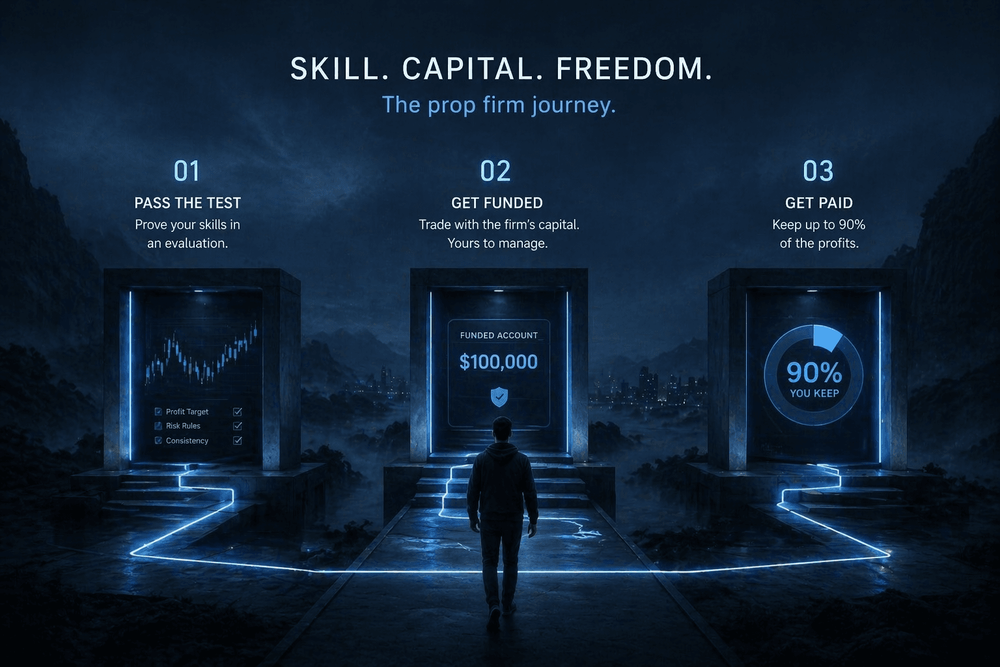
Step 1: You Take a Test
Before any firm gives you real money, they want to see you trade. So they set up a practice account with fake money and give you rules to follow.
The rules usually look like this:
- Make a profit. Hit a small target, like earning 6% to 10%.
- Don't lose too much. Stay within a daily loss limit and a total loss limit.
- Trade on multiple days. Show it's not just one lucky shot.
This test is called the prop firm evaluation (some firms call it a challenge or combine). You pay a one-time fee to take it. If you fail, you lose that fee and nothing more. If you pass, you move to step two.
Step 2: You Get a Funded Account
Pass the test and the firm gives you a funded account to trade. The size depends on which evaluation you took, but it usually ranges from $25,000 to $300,000.
Here's the cool part: you didn't deposit that money. The firm put it up. You just have to keep following the same basic rules (don't blow up, stay consistent), and any profits you make are real.
Step 3: You Get Paid
When you make money, you request a payout. The firm sends you your share, usually 80% to 90% of the profits. They keep the rest.
Good firms pay fast. Some within a day or two. Most within a week.
What Do You Actually Trade?
Most modern prop firms focus on one of two things:
Futures. These are agreements to buy or sell things like oil, gold, or the S&P 500 index at a set price on a set date. Sounds complicated, but futures trade a lot like stocks, just with a few extra features. You can trade them almost 24 hours a day, and you can make money whether the market goes up or down.
Forex or CFDs. These are currencies and other contracts. The rules and execution quality vary more from firm to firm here.
Futures prop firms are the more regulated, professional end of the space. They route orders through serious infrastructure like Rithmic™ straight to the real exchanges. If you're new and want a firm you can trust, a futures prop firm is usually the safer choice.

What's the Catch?
Honest answer: it's harder than the ads, influencers, and your trading buddies make it sound.
The rules are strict for a reason. If the firm let anyone trade their capital with no guardrails, they'd go bankrupt. So evaluations are designed to filter out reckless traders. Most people who try don't pass on the first attempt.
But here's the flip side. You're not gambling your savings. The worst case is you lose the evaluation fee, which is usually $50 to $500. Compare that to losing real money in your own trading account and it's a very different risk.
Who Is a Prop Firm For?
Good fit if you:
- Already have a trading strategy you've tested
- Want to trade bigger size without risking your own savings
- Can follow rules and stay disciplined
- Like structure and clear goals
Not a good fit if you:
- Have never traded before at all
- Are looking for a get-rich-quick scheme
- Can't handle losing trades without going on tilt
- Don't want to follow any rules
If you're brand new, spend time on a free simulator first. Learn how markets move. Build a strategy. Then take the evaluation once you're ready. Visit https://app.tradesea.ai/trade
How Tradesea™ Fits In
A funded account only matters if the tools you trade with are fast and reliable. A slow chart or a laggy order button can cost you the evaluation before you even know what happened.
That's what we build at Tradesea.
- Station is our trading terminal. Built for speed, low latency, designed for the way funded traders actually work.
- Compass is our analytics and journaling tool. It tracks your trades, gives you a Compass-score for how well you're trading, and shows you exactly what's working and what isn't.
- Polaris is our AI engine. Add indicators, test strategies, and build setups with one command, so you spend time trading instead of fighting your charts.
Whether you're funded at Lucid, Tradeify, Blusky etc, Tradesea gives you the gear you need to actually keep that account alive.
The Bottom Line
A prop firm gives you a chance to trade with real size without risking real savings. You prove your skills on a test account. You get funded. You trade. You get paid.
It's not easy. But it's one of the fairest setups retail traders have ever had.
If you're going to do it, do it with tools that won't hold you back. Try Tradesea.ai We built Station, Compass, and Polaris and many things for exactly this: helping funded traders stay funded.