Why Your Fill Price Is Not Always the Price You Clicked
You clicked Buy. Now what? Between pressing a button and seeing a confirmation on your screen, your order travels through an entire chain of systems. Most traders never think about this until a fill comes back in a way they did not expect: too slow, only partially done, or at a slightly different price. Understanding how this works is the foundation of knowing why execution quality matters.
What Is a Fill?
When you place a trade, you are sending an instruction to the Exchange : buy this, sell this, at this price, in this quantity. A fill is the confirmation that the market accepted your instruction and matched it with someone on the other side. Think of it like placing an order at a restaurant. You placed the order, but you are not eating yet. The fill is when the food actually arrives at your table.
Fills come in a few different forms, and not all are equal:
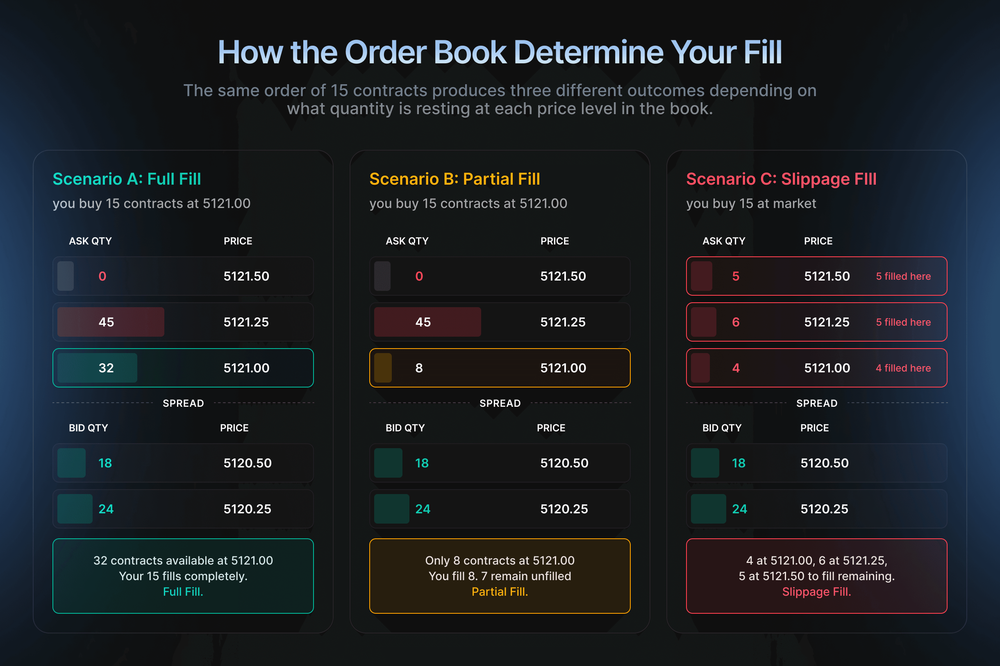
To understand how orders are filled, you have to look "under the hood" at the Order Book. The Order Book is a real-time list of buy and sell interest, organized by price level. There are two primary ways to interact with this book: you either provide liquidity (waiting for a price) or take liquidity (demanding a price now).
1. The Order Book Structure: The book is divided into two sides. The gap between them is the Spread. The Ask (Sellers): Resting Limit Orders from people waiting to sell at higher prices. The Bid (Buyers): Resting Limit Orders from people waiting to buy at lower prices.
2. Limit Orders (Liquidity Makers): A Limit Order is an instruction to buy or sell only at a specific price or better. Behavior: When you submit a Limit Order, it does not execute immediately unless the market is already at your price. Instead, it sits in the book as Resting Liquidity. The "Queue": Most exchanges use FIFO (First In, First Out). If you and another trader both want to buy at 5121.00, whoever placed the order first gets filled first.
Fill Outcomes:
Full Fill: Price hits your level, and there is enough volume to satisfy your entire order.
Partial Fill: Price hits your level, but the market moves away before your "spot in line" is fully reached.
No Fill: The market never reaches your price. Key Takeaway: Limit orders guarantee Price, but they do not guarantee Execution.
3. Market Orders (Liquidity Takers): A Market Order is an instruction to buy or sell immediately at the best available current price.
Behavior: It does not "sit" in the book. It aggressively "hits" the resting Limit Orders on the opposite side.
The "Sweep": If you want to buy 100 contracts but there are only 50 available at the best price, a Market Order will automatically "sweep" up to the next price level to find the remaining 50.
Fill Outcomes:
Slippage: This is the difference between the price you saw when you clicked "Buy" and the actual average price you received. Large market orders in "thin" (low volume) markets cause massive slippage.
Key Takeaway: Market orders guarantee Execution, but they do not guarantee Price. A simulator doesn't just watch the price; it tracks the L1 (Top of Book) and L2 (Market Depth) data to decide if your "fake" money would have actually been filled in the real world.
1. Mirroring Limit Orders (Queue Position): In a real exchange, your limit order has a "place in line" (FIFO). Basic Simulators: Often fill you the moment the price touches your limit. This is unrealistic because, in the real world, there might be 500 contracts ahead of you and the price could bounce before you are filled.
Pro Simulators: These track Volume at Price. They won't fill your buy limit at 5121.00 until they see that a certain amount of actual market sell orders have occurred at that level, proving your "place in line" would have been reached.
2. Mirroring Market Orders (Slippage Simulation): Simulators must calculate how much "Liquidity" is available to fill a market order.
The Calculation: If you place a market order for 50 contracts on a simulator, it looks at the current Ask side of the book. If there are only 10 contracts at the best price, the simulator "fills" you by moving up the levels, just like a real exchange.
Reality Check: If the simulator doesn't account for depth, it gives you a "perfect" fill that you could never get in a live, thin market.
How Rithmic Mimics the Exchange
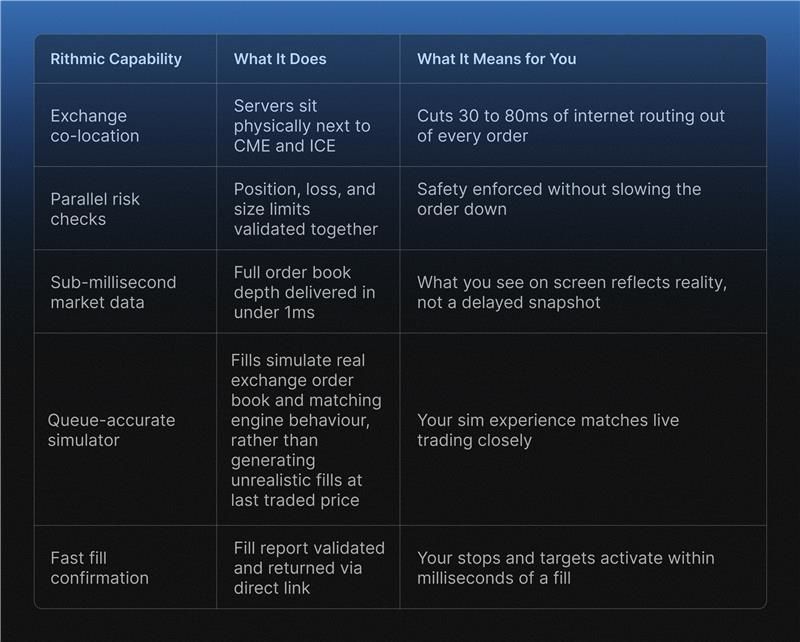
Most simulators make a simplifying assumption: if the market traded at your price, you got filled. That sounds reasonable but it is wrong. In a real exchange, your order joins a queue. If 500 contracts are already resting at 5121.00 ahead of you and only 200 trade at that level, you get nothing. The 200 went to the orders that arrived before yours.
Rithmic replicates this. It models the actual order queue, tracks your position within it, and only fills you when enough volume has traded through the levels ahead of you. It also replicates the matching engine logic: price-time priority, partial fills arriving as separate confirmations, and order book depth that reflects real resting liquidity rather than a synthetic feed.
The result is that your simulator experience on tradesea is not an approximation of live trading. It is the same mechanics, running on the same infrastructure, without real money attached.
The Journey of an Order: 7 Steps from Click to Confirmation
Most people experience a fill as one event. In reality, it is a chain of seven steps, and time accumulates at every single one:
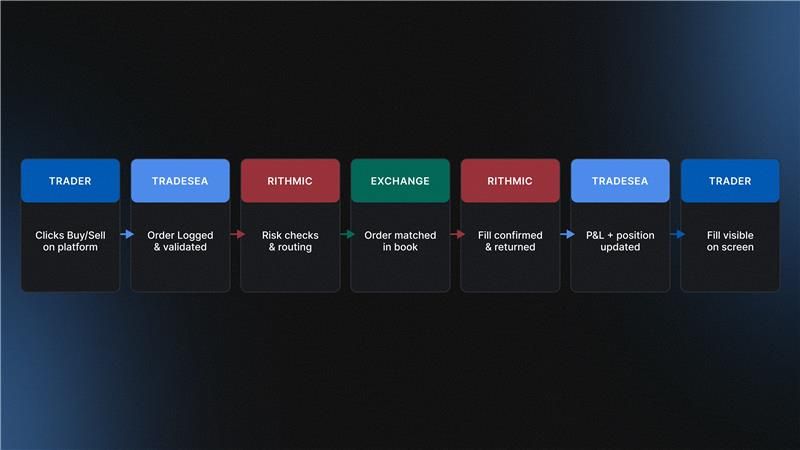
Fig. 2: The complete order journey, from the moment you click to the confirmation you see on screen
1. Click. You press Buy or Sell. The order is created with your chosen price, size, and order type. The clock starts the moment you click.
2. tradesea. The platform receives your order, checks it for obvious errors, and prepares it for transmission. Station completes this step in under 10 milliseconds.
3. Rithmic. Your order enters the Rithmic network. Safety checks run instantly to make sure the order respects position limits and risk rules, then it is sent directly to the exchange.
4. Exchange. The order joins the exchange order book and waits to be matched with someone on the other side. This step is governed entirely by the exchange and is outside any platform's control.
5. Rithmic. The exchange confirms the match and sends fill reports to Rithmic. For larger orders, fills can arrive in chunks, the exchange matches your order level by level through the book, and each matched portion comes back as a separate confirmation. Rithmic validates each one and passes them back to your platform in sequence.
6. tradesea. Station receives the fill, updates your position and profit and loss, and activates any stop or target orders you had attached.
7. Screen. You see the confirmation. The full round trip takes roughly 47 milliseconds on Rithmic, compared to 135 milliseconds or more on older platforms.
Why Fills Can Be Slow: Where the Time Goes
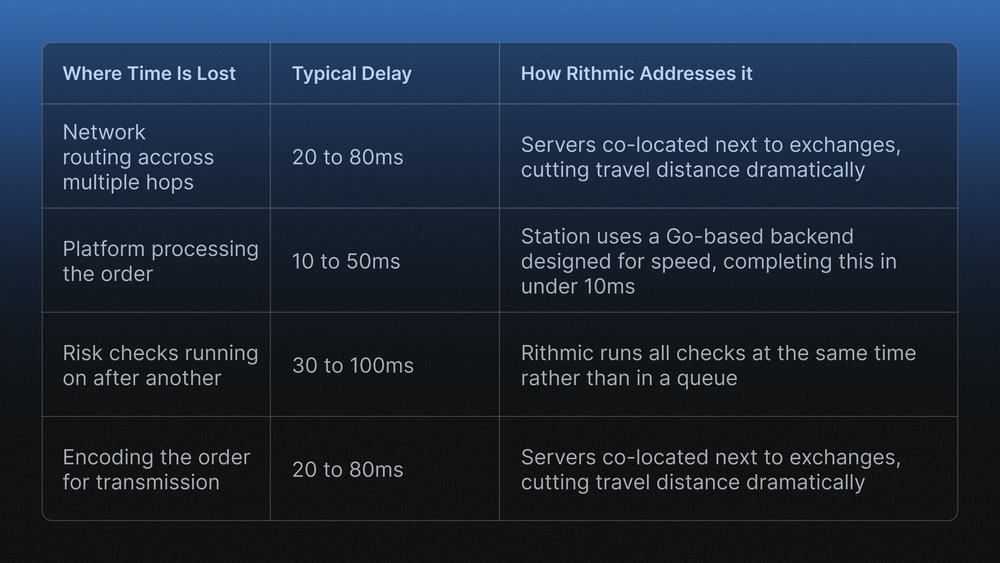
Slow fills are rarely caused by one thing. They are the result of small delays adding up at multiple points along the order chain. Here is where time gets lost, and how the tradesea and Rithmic combination addresses each one:
Why Small Delays Add Up
Think of it like a relay race. Each runner adds only a few seconds, but by the time the baton reaches the finish line, the total time is what determines whether you win or lose. A 20ms delay here, a 30ms delay there, and suddenly your order is arriving at the exchange 100 to 150ms after you clicked. In a fast-moving market, prices can shift significantly in that window.
What Rithmic Actually Does
Rithmic is not a trading platform you see or interact with directly. It is the professional-grade infrastructure that sits between Tradesea and the exchange, doing the heavy lifting that makes fast, reliable execution possible. Think of it as the high-speed express lane that your order travels through rather than the regular road.
How tradesea Station Uses Rithmic
Rithmic provides the fast road. Station is built to drive on it without wasting any of the advantage.
Go-based backend. Station's server code is written in Go, a programming language purpose-built for handling many things at once without slowing down. It processes order routing, position updates, and market data simultaneously, completing its share of the work in under 10 milliseconds.
Efficient data transmission. Orders between Station and Rithmic use a compact format called Protocol Buffers over a persistent connection. This avoids the overhead of repeatedly establishing new connections and keeps the data being transmitted as lean as possible.
A frontend that keeps up. A fast backend only matters if your screen reflects fills immediately. Station uses a modern interface architecture that updates only the parts of the screen that changed on each fill. Your position, profit and loss, and order status all refresh within a single screen frame.
The Bottom Line
A fill is not just a notification. It is the result of an entire system working correctly on your behalf, from the moment you click through to the exchange and back. The faster and more reliably that chain operates, the closer your actual results will match your intentions.
Rithmic is one of the most trusted execution networks in professional futures trading, used by brokers, funding evaluators, and futures commission merchants globally. tradesea is built to use it fully, from the backend code to the way information is transmitted to the way your screen updates.
Your edge starts before the entry. It starts when the order leaves your screen.
Experience Rithmic-Powered Execution on Station
tradesea is available through participating Brokers, FCMs, and Funding Evaluators. Visit www.tradesea.ai or contact your Funding Evaluator to confirm access.
Risk Warning: Futures trading involves substantial risk of loss and is not suitable for all investors. Leverage amplifies both profits and losses. Past performance does not guarantee future results. Latency and fill data are illustrative. Trade only with capital you can afford to lose. Seek professional advice before trading.